
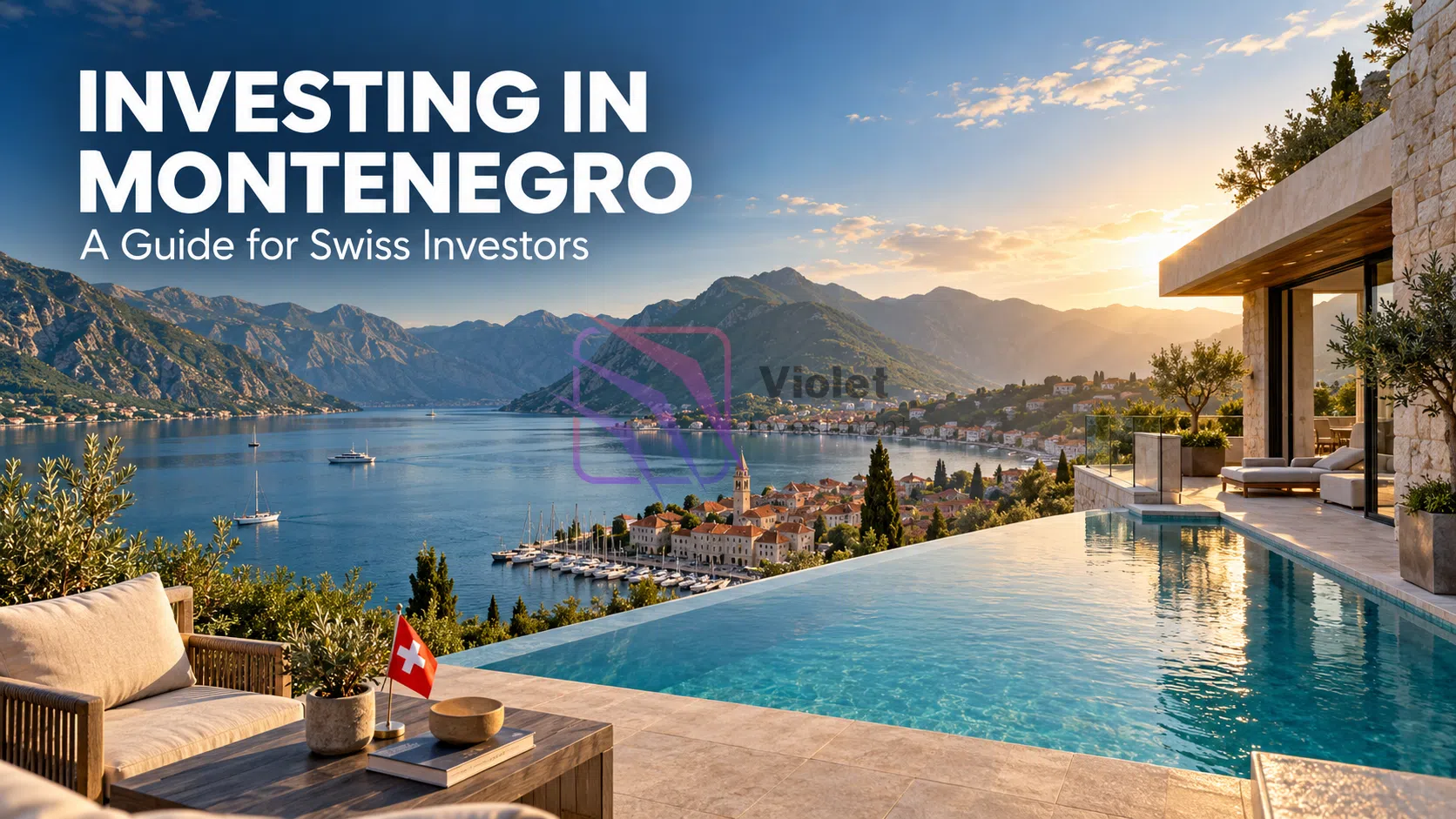
Montenegro gives Swiss investors access to euro-denominated property, Adriatic coastal living, international tourism and an emerging European real estate market—often at substantially lower prices than Switzerland and many established Mediterranean destinations.
From luxury marina residences in Tivat to holiday properties in Budva, waterfront homes around the Bay of Kotor and year-round rental investments in Podgorica, Montenegro offers opportunities for several different investment strategies.
However, a successful investment requires more than finding an attractive sea-view property. Buyers must verify ownership, construction legality, planning conditions, taxes, rental demand and the realistic resale market before committing funds.
This guide explains the principal rules, prices, taxes, potential returns and investment strategies Swiss buyers should consider before purchasing property in Montenegro.
Why Montenegro Appeals to Swiss Investors
For Swiss investors, Montenegro offers a combination of accessibility, lifestyle and relative affordability.
The principal advantages include:
- Euro-denominated real estate
- Generally open ownership rules for Swiss citizens
- Lower entry prices than Switzerland and many EU coastal markets
- Direct and connecting flight access from Switzerland
- Established international tourism
- Luxury marina and branded-residence developments
- Long-term and seasonal rental opportunities
- Limited supply in prime coastal locations
- Lower property-maintenance and operating costs
- Potential medium- to long-term capital appreciation
- The possibility of combining personal use with rental income
Montenegro can work particularly well as a second-home market. Owners can enjoy the property personally while maintaining it as part of a diversified international real estate portfolio.
Swiss Franc and Euro Diversification
Montenegro uses the euro, even though it is not yet a member of the European Union.
A Montenegro property therefore gives a Swiss buyer direct exposure to a euro-denominated tangible asset. This can diversify a portfolio otherwise concentrated in Swiss francs.
Currency movements can affect the investment in both directions. When calculating performance, Swiss investors should measure:
- Original purchase price in CHF
- Rental income received in EUR
- Operating expenses in EUR
- Future selling price in EUR
- EUR/CHF exchange rate at purchase and sale
- Currency-conversion and international-transfer costs
A property can increase in euro value while producing a weaker return in Swiss francs if the euro depreciates. Currency exposure should therefore be included in every investment calculation.
Montenegro’s European Union Opportunity
Montenegro is one of the most advanced candidates for European Union membership. All negotiating chapters have been opened, and additional chapters were provisionally closed during 2026.
Continued European integration may support:
- Institutional and judicial reforms
- Better infrastructure
- Stronger property-market regulation
- Greater international investor confidence
- Increased demand from European buyers
- Improved transparency and digital administration
- Long-term economic development
EU membership is not guaranteed and no final accession date should be presented as certain. Investors should treat future membership as potential long-term upside rather than the sole reason to buy.
Can Swiss Citizens Buy Property in Montenegro?
Swiss citizens can generally purchase apartments, houses, villas, commercial premises and most urban construction land in Montenegro directly in their personal names.
A Montenegrin company is not normally required for a standard residential purchase.
Restrictions and additional rules can apply to:
- Agricultural land
- Forests and forest land
- Certain islands
- Protected natural or cultural areas
- Strategic or border-zone property
- Land affected by restitution claims
- Development land without confirmed planning conditions
A Montenegrin limited liability company, known as a DOO, may sometimes be appropriate for a development project, commercial activity or restricted land category. However, company ownership introduces accounting, tax and administrative obligations in Montenegro and may also create Swiss reporting consequences.
The purchase structure should be agreed with Montenegrin and Swiss advisers before a reservation agreement is signed.
Can Swiss Owners Obtain Residence in Montenegro?
Ownership of qualifying property may provide a basis for applying for temporary residence in Montenegro.
Under the 2026 amendments, non-EU, non-EEA and non-Swiss nationals generally face a €150,000 assessed property-value requirement. Swiss citizens are included with the exempt European categories and are therefore not generally subject to this minimum-value condition.
Applicants must still satisfy the other applicable residence requirements, which can include:
- Valid passport
- Proof of ownership
- Accommodation registration
- Medical insurance
- Evidence of sufficient funds
- Criminal-record documentation
- Payment of administrative fees
- Other documents requested by the Ministry of Interior
The residence permit is normally temporary and renewable. Property ownership does not automatically provide permanent residence, citizenship or employment rights.
Montenegro is not currently part of the EU or Schengen Area. A Montenegrin residence card should therefore not be marketed to Swiss citizens as providing additional Schengen mobility, because Switzerland is already a Schengen member.
Immigration rules can change, so the current requirements should be confirmed before purchasing a property specifically for residence purposes.
How the Property-Purchase Process Works
1. Define the Investment Objective
Before reviewing properties, determine:
- Total investment budget
- Intended personal use
- Preferred location
- Long-term or short-term rental strategy
- Target return
- Acceptable risk level
- Expected holding period
- Need for residence
- Financing requirements
- Future resale audience
2. Select and Inspect the Property
The investor should inspect the property personally or appoint an independent professional to do so.
For new developments, review:
- Developer experience
- Previously completed projects
- Construction specifications
- Land ownership
- Planning documentation
- Payment schedule
- Delivery date
- Delay protections
- Handover procedure
3. Agree on the Commercial Terms
The offer or reservation document should clearly state:
- Purchase price
- Reservation payment or deposit
- Payment deadlines
- Included furniture and equipment
- Completion date
- Conditions for refunding the deposit
- Responsibility for taxes and fees
- Consequences of legal or technical problems
A substantial deposit should not be transferred before the property and seller have been independently checked.
4. Conduct Legal Due Diligence
The buyer’s independent lawyer should verify:
- Registered owner
- Cadastral description
- Registered property area
- Mortgages and liens
- Court disputes and restrictions
- Building permit
- Use permit
- Legalization status
- Planning conditions
- Road access and easements
- Property-tax and utility debts
- Seller’s legal authority
- Developer’s right to construct and sell
5. Sign the Notarized Agreement
The final purchase agreement is generally signed or certified before a Montenegrin notary.
A buyer who cannot travel may be represented through a properly drafted and legalized power of attorney.
6. Transfer Funds
Payments should be completed through traceable banking channels. Banks, lawyers and notaries may request evidence showing the legal source of funds.
7. Register Ownership
Following completion, the ownership change is submitted to Montenegro’s Real Estate Administration for cadastral registration.
The agreement should clearly regulate possession, keys, utilities and risk during the period between signing and final registration.
Taxes and Buying Costs
Real Estate Transfer Tax
For resale properties that are not subject to VAT, Montenegro applies progressive transfer-tax rates:
| Property value | Transfer-tax calculation |
|---|---|
| Up to €150,000 | 3% |
| €150,000.01–€500,000 | €4,500 plus 5% of the amount above €150,000 |
| Above €500,000 | €22,000 plus 6% of the amount above €500,000 |
These rates have applied since January 1, 2024. Montenegro Revenue and Customs Administration
For a qualifying first sale by a VAT-registered developer, VAT is generally included in the purchase price and transfer tax is not usually charged on the same transaction. The treatment of the specific property must be confirmed before purchase.
Annual Property Tax
Annual property tax is generally calculated at between 0.25% and 1.00% of the property’s assessed market value, depending on the municipality, property type, use and local factors. Government of Montenegro
Additional Expenses
A buyer should also budget for:
- Legal fees
- Notary expenses
- Official translations
- Cadastral registration fees
- Bank-transfer and currency-conversion costs
- Property inspection
- Agency commission, where applicable
- Furnishing and equipment
- Insurance
- Building maintenance
- Property management
Swiss Tax Considerations
A Swiss tax resident generally must disclose foreign real estate in their Swiss tax return.
Montenegro property is normally taxable primarily in the country where the property is located. However, the property’s value and associated income may still affect the tax rate applied to the investor’s other income and assets in Switzerland.
Foreign property can therefore be relevant for:
- Cantonal and municipal wealth-tax calculations
- Income-tax progression
- Actual or imputed rental value
- Allocation of mortgages and deductible interest
- Capital-gains reporting
- Rental-income disclosure
- Ownership through a foreign company
Swiss guidance states that foreign properties are generally exempt from direct Swiss taxation but remain relevant when determining applicable tax rates. Treatment varies by canton and individual circumstances. Swiss tax overview
Switzerland and Montenegro have concluded a double-taxation agreement. Swiss Federal Tax Administration
The treaty can allocate taxing rights and provide mechanisms against double taxation, but it does not remove the requirement to file the necessary declarations.
Swiss investors should consult an adviser in their canton together with a Montenegrin accountant, particularly when purchasing through a company or using financing secured against Swiss assets.
Indicative Property Prices in Montenegro
Recent market reporting placed the average national price of new residential construction at approximately €2,210 per m² at the beginning of 2026, although actual prices vary substantially by location and property quality.
Indicative 2026 asking-price ranges include:
| Location | Indicative apartment prices |
|---|---|
| Podgorica | €1,900–€2,800 per m² |
| Bar | €1,800–€3,200 per m² |
| Budva and Bečići | €2,500–€4,500+ per m² |
| Kotor and surrounding bay | €2,500–€5,000+ per m² |
| Herceg Novi | €2,200–€4,000+ per m² |
| Tivat | €3,000–€6,000+ per m² |
| Branded luxury resorts | €5,000–€12,000+ per m² |
Properties in Porto Montenegro, Luštica Bay, Portonovi and selected waterfront developments can exceed these general ranges.
The price per square meter should always be assessed together with:
- Exact location
- View and orientation
- Distance from the sea
- Parking
- Construction quality
- Energy efficiency
- Documentation
- Rental potential
- Building maintenance
- Future resale demand
What Rental Return Can Swiss Investors Expect?
Market data placed Montenegro’s average gross residential rental yield at approximately 4.84% in the second quarter of 2026, although individual properties can perform above or below that level. Global Property Guide
Indicative target ranges are:
| Investment strategy | Possible gross annual yield |
|---|---|
| Podgorica long-term rental | Approximately 4%–6% |
| Coastal long-term rental | Approximately 4%–6% |
| Professionally managed coastal holiday rental | Approximately 5%–8% |
| Premium branded residence | Approximately 3%–5% |
| Renovation or value-add investment | Potentially higher, with greater risk |
Gross yield is not the investor’s final return. Net income will be lower after:
- Vacancy
- Rental management
- Booking-platform fees
- Cleaning and laundry
- Utilities
- Maintenance
- Insurance
- Annual property tax
- Rental-income tax
- Furniture replacement
Example Investment Calculation
Consider a furnished apartment purchased for €250,000:
- Purchase price: €250,000
- Taxes and professional expenses: €15,000
- Furnishing and preparation: €10,000
- Total capital invested: €275,000
- Expected annual gross rent: €17,600
- Gross return on total capital: approximately 6.4%
- Estimated annual operating expenses: €5,500
- Income before personal tax: €12,100
- Net return before tax: approximately 4.4%
The result in Swiss francs will also depend on the EUR/CHF exchange rate.
Every investment forecast should include conservative, expected and optimistic scenarios.
Best Investment Strategies for Swiss Buyers
1. Tivat and Luxury Marina Property
Tivat is suitable for investors seeking:
- Premium developments
- Marina living
- International tenants
- Lifestyle use
- Professional property management
- International resale demand
- Potential long-term appreciation
Porto Montenegro, Boka Place and Luštica Bay attract buyers looking for a managed environment and high construction standards.
These properties may offer lower rental yields than independent apartments, but they can provide stronger management, amenities and international liquidity.
2. Bay of Kotor Second Homes
Kotor, Dobrota, Muo, Prčanj, Perast and Risan combine historic character with dramatic mountain and sea scenery.
The strongest properties normally offer:
- Unobstructed views
- Parking
- Walkable waterfront access
- Outdoor space
- Modern interiors
- Clean documentation
- Practical year-round access
Traffic, parking, humidity and maintenance of older stone buildings should be examined carefully.
3. Budva and Bečići Rental Apartments
Budva is one of Montenegro’s strongest tourism and holiday-rental markets.
Well-positioned one- and two-bedroom apartments can serve:
- Summer tourists
- Medium-term tenants
- Relocating residents
- Owners seeking personal holiday use
The investment should remain financially sensible even if summer occupancy or nightly prices fall below expectations.
4. Podgorica Long-Term Rentals
Podgorica offers less seasonality and more consistent year-round demand.
Suitable properties include:
- Modern one-bedroom apartments
- Efficient two-bedroom apartments
- Homes near business districts and universities
- Apartments with garage parking
- New buildings with good energy efficiency
This strategy can suit Swiss investors seeking stable occupancy and simpler management.
5. Bar as a Value Market
Bar offers lower entry prices than Tivat, Kotor and central Budva while providing year-round infrastructure.
It may suit buyers looking for:
- Larger properties for the same budget
- Long-term rental income
- Renovation opportunities
- A personal-use home
- Medium- to long-term appreciation
6. New Developments With Payment Plans
Off-plan projects can provide staged payments, but investors must verify:
- Land ownership
- Planning and construction documentation
- Developer history
- Construction specifications
- Completion deadlines
- Delay penalties
- VAT treatment
- Handover conditions
- Final registration obligations
A payment plan should never replace legal and financial due diligence.
7. Development Land
Land can provide higher returns but also carries greater planning and construction risk.
The investor must verify:
- Urbanized status
- Permitted use
- Building coefficient
- Site-occupancy coefficient
- Maximum gross construction area
- Floor and height limits
- Road access
- Utilities
- Infrastructure contributions
- Environmental restrictions
- Coastal-zone conditions
The cadastral area of a parcel is not the same as the area that can legally be built.
Due-Diligence Checklist
Before purchasing, verify:
- Current cadastral title
- Registered owner
- Mortgages and liens
- Court disputes
- Registered area
- Building and use permits
- Legalization status
- Planning conditions
- Road and utility access
- Property-tax debts
- Building-maintenance obligations
- Rental restrictions
- Developer warranties
- Parking and storage registration
- Furniture inventory
- Realistic rental forecast
- Future resale market
Common Mistakes to Avoid
Swiss investors should avoid:
- Buying based only on photographs
- Paying a substantial deposit before legal checks
- Assuming every sea-view plot is buildable
- Comparing gross yield with net investment return
- Ignoring EUR/CHF currency risk
- Underestimating coastal maintenance
- Assuming EU membership is guaranteed
- Buying unregistered additions or terraces
- Forming a company without tax advice
- Ignoring Swiss foreign-property reporting
- Choosing property only by the lowest price per square meter
- Accepting projected rental figures without comparable evidence
Is Montenegro a Good Investment for Swiss Buyers?
Montenegro can be attractive for Swiss investors seeking euro-denominated property, lower Mediterranean entry prices, international tourism exposure and personal lifestyle use.
The most suitable location depends on the objective:
- Podgorica: stable year-round rental demand
- Budva: tourism and hybrid rental potential
- Tivat: premium lifestyle and international resale demand
- Kotor Bay: distinctive second homes and holiday properties
- Bar: lower entry prices and longer-term value potential
The strongest investment is not necessarily the cheapest or most luxurious property. It is the property with secure documentation, sustainable demand, manageable operating costs and a clear future resale audience.
How Violet Investment Supports Swiss Investors
Violet Investment serves clients from around the world and provides professional property and investment services across Montenegro and other international markets.
We assist Swiss investors with:
- Investment-strategy consultation
- Property sourcing
- On-market and selected off-market opportunities
- New-development comparisons
- Price and rental analysis
- Developer evaluation
- Negotiation and offer preparation
- Coordination with independent lawyers and accountants
- Remote purchase through power of attorney
- Inspection and handover
- Furnishing and rental preparation
- Property-management coordination
- Resale and portfolio planning
Our objective is to help each investor choose property based on legal security, market value, financial performance and long-term potential.
Invest in Montenegro With Local Expertise
If you are considering a holiday home, rental investment, marina residence, villa or development opportunity in Montenegro, Violet Investment can prepare a personalized property selection based on your budget and investment objectives.
Violet Investment DOO
International Real Estate & Investment Agency
Hercegovačka 2, Podgorica, Montenegro
www.violetinvestment.com
Disclaimer: This article is provided for general informational and marketing purposes only. It does not constitute legal, immigration, tax or financial advice. Property prices, tax rules, residence requirements and expected returns can change. Investors should obtain independent professional advice in Montenegro and Switzerland before completing a transaction.


Join The Discussion