
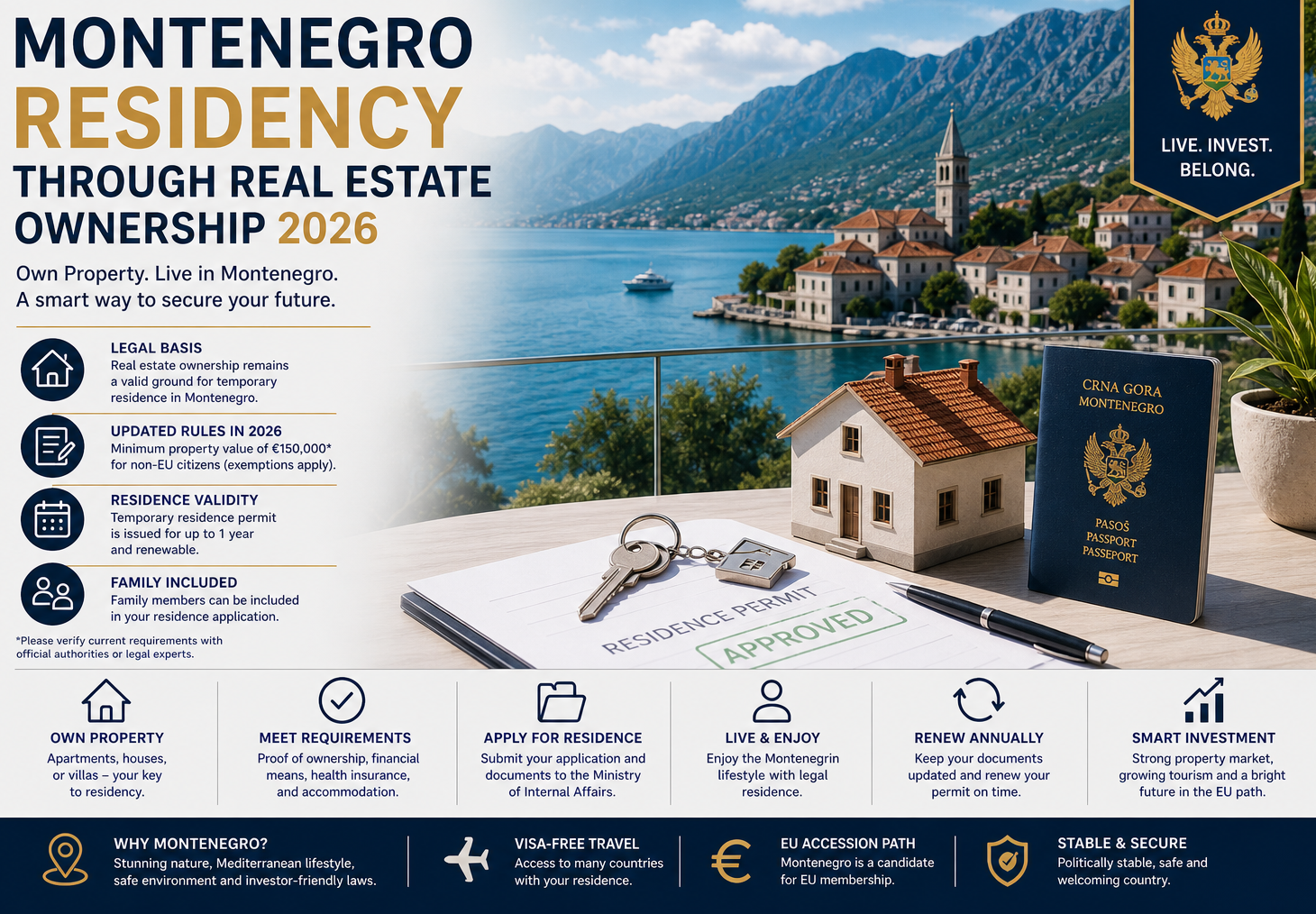
Montenegro continues to attract international buyers who are looking for more than a holiday home. For many investors, Montenegro offers a rare combination of lifestyle, real estate value, rental potential, and the possibility of applying for temporary residence through property ownership.
In 2026, ownership of real estate remains one of the legal grounds for applying for temporary residence in Montenegro. This means that a foreign buyer may purchase property and, if the required conditions are met, apply for a temporary residence permit based on ownership and use of that property.
However, the rules are now more structured than before. Property ownership should not be misunderstood as automatic residency. It is a legal basis for application, but approval still depends on meeting the current requirements, preparing the correct documents, and following the proper procedure.
The most important update for 2026 is the introduction of a minimum property value threshold. The currently approved threshold for temporary residence based on real estate ownership is €150,000 for applicable non-EU foreign nationals. This threshold is based on the taxable value of the property as assessed through the Montenegrin tax process, not only the asking price or purchase price.
At Violet Investment, we help foreign buyers approach Montenegro real estate with a clear strategy. Whether your goal is lifestyle, rental income, long-term investment, or temporary residence planning, our team can help you compare suitable options and avoid common mistakes.
To explore current opportunities, browse our properties for sale in Montenegro, review selected Montenegro real estate projects, or request a private property and residency consultation with Violet Investment.
Can You Get Residency in Montenegro by Buying Property in 2026?
Yes. In 2026, a foreigner may still apply for temporary residence in Montenegro based on real estate ownership.
This route is especially attractive for buyers who want to spend more time in Montenegro, enjoy a Mediterranean lifestyle, invest in property, or create a long-term base in the country.
That said, the residence granted through this route is temporary residence. It is not citizenship, it is not permanent residence, and it is not automatically a work permit.
The correct way to understand this route is simple:
Property ownership gives you a legal basis to apply for temporary residence. It does not automatically grant residence by itself.
A buyer must still meet the legal and administrative requirements, including proof of ownership, proof of actual use of the property, health insurance, means of subsistence, valid travel documents, and other application conditions.
If your goal is to purchase property specifically for residence planning, Violet Investment can help you identify suitable options. Start by reviewing our properties for sale in Montenegro or contact our advisory team for private guidance.
What Changed in 2026?
The 2026 changes made Montenegro’s property-based residence route clearer and more regulated.
Previously, foreign buyers could often apply for temporary residence based on property ownership without a minimum property value requirement. This made the route very accessible, but it also created inconsistencies in the market.
From 2026, Montenegro introduced a clearer threshold. For applicable non-EU foreign nationals, the property used for temporary residence must have a minimum taxable value of €150,000.
This threshold is important because it creates a more serious and transparent framework. It also means that buyers who are purchasing property with residency in mind must choose the property carefully and confirm that it meets the current requirements before buying.
For buyers seeking residence-oriented properties, our team can help compare suitable apartments, houses, villas, and new-build options. Explore selected Montenegro real estate projects or browse apartments and properties for sale in Montenegro.
Important Clarification: The Threshold Is €150,000, Not €200,000
There has been confusion in the market because an earlier proposed figure of €200,000 was discussed. However, the rule currently approved and applied in 2026 is €150,000 for the relevant category of applicants.
This distinction is important for foreign buyers.
The current requirement is not based only on the purchase price written in the contract. It is based on the taxable value of the property, as assessed through the Montenegrin tax process. This means that a buyer should not simply assume that a property qualifies because the asking price or sale price is above €150,000.
For residency planning, the key question is:
Will the official taxable value of the property meet or exceed €150,000?
If residency is one of the reasons for buying, this should be checked before committing to the purchase.
Violet Investment advises buyers to review the property’s residence suitability before signing. For tailored support, request a Montenegro property and residency consultation.
Who Does the €150,000 Rule Apply To?
The €150,000 minimum taxable property value applies mainly to third-country nationals, meaning non-EU/EEA/Swiss applicants.
The requirement does not apply in the same way to citizens of EU member states, Iceland, Liechtenstein, Norway, and Switzerland. Certain family members may also be treated differently depending on their legal status and nationality.
Because each buyer’s situation can be different, foreign investors should confirm their position before structuring a purchase around residence planning.
At Violet Investment, we provide tailored advisory for different buyer profiles, including American, Turkish, Chinese, Middle Eastern, British, and other non-EU buyers, as well as EU citizens who want to understand long-stay options in Montenegro.
Does Buying Property Automatically Grant Residency?
No. Buying property in Montenegro does not automatically grant temporary residence.
This is one of the most important points for foreign buyers to understand.
A property purchase gives the buyer a legal basis to apply, but the application must still be reviewed and approved by the competent authorities. The applicant must meet the general conditions for temporary residence and provide the required documents.
In practice, the applicant should expect to prove:
Ownership of the property
Actual use of the property
Valid travel document
Health insurance
Means of subsistence
Accommodation in Montenegro
Clean legal and immigration status
Settlement of property tax obligations
Property value eligibility, where applicable
A property purchase should therefore be treated as part of a properly prepared residence application, not as an automatic guarantee.
Does This Type of Residence Allow You to Work in Montenegro?
No. Temporary residence based on real estate ownership does not automatically give the right to work or conduct business activity in Montenegro.
This residence category is linked to property ownership and use. If a foreigner wants to work, become employed, operate a company, or perform business activities in Montenegro, a different legal basis or additional permits may be required.
This is especially important for investors, entrepreneurs, remote professionals, and business owners.
A buyer may own property and apply for temporary residence through that property, but work rights must be reviewed separately.
How Long Is the Residence Permit Valid?
Temporary residence based on real estate ownership is generally issued for one year and may be renewed if the conditions continue to be met.
Renewal should not be left until the last moment. Buyers should keep their documents updated and monitor deadlines carefully.
For renewal, the applicant may need to show continued ownership, continued use of the property, valid insurance, means of subsistence, and compliance with tax and residence obligations.
If you are planning to stay in Montenegro before buying, you may also compare current rental properties in Montenegro while preparing your long-term property strategy.
Can You Lose Temporary Residence?
Yes. Temporary residence can be lost if the conditions are no longer met.
For example, residence may be affected if:
The property is sold
The applicant no longer uses the property
Required taxes are not paid
Documents are not renewed on time
The applicant stays outside Montenegro longer than permitted
The original basis for residence no longer exists
The applicant does not comply with legal requirements
This means that property-based temporary residence requires ongoing compliance. It is not enough to buy a property and forget about the administrative obligations.
Is a Visa Required Before Applying?
This depends on the applicant’s nationality.
Some foreign nationals can enter Montenegro visa-free for a limited period, while others may need a visa before entering or before applying for temporary residence.
For nationals who require a visa, the 2026 framework is stricter. In many cases, a Type D visa may be required before submitting the residence application based on property ownership.
Foreign buyers should check their visa position before traveling to Montenegro or before planning the timing of their application.
At Violet Investment, we advise buyers to plan their travel, property viewings, purchase schedule, and residence application timing carefully. To begin, contact Violet Investment for private advisory.
What Documents Should Buyers Prepare?
The exact documents can depend on nationality, personal circumstances, and the competent authority’s requirements. However, buyers applying for temporary residence through real estate ownership should generally expect to prepare:
Valid passport
Proof of property ownership
Cadastre documentation
Proof of taxable property value, where applicable
Proof of actual use of the property
Proof of health insurance
Proof of financial means
Proof of accommodation
Evidence that property taxes are settled
Application forms
Photographs and biometric data
Police or background documents, where required
Translations and notarized documents, where required
Because requirements can change or be interpreted differently depending on the case, buyers should prepare the file carefully and avoid incomplete applications.
Step-by-Step: Montenegro Residency Through Real Estate Ownership
1. Define Your Goal Before Buying
Before choosing a property, decide whether your goal is lifestyle, rental income, long-term investment, temporary residence, or a combination of these.
If residency is part of the goal, the property should be selected with the residence requirements in mind.
For buyers who are still comparing locations, our team can help you understand the difference between coastal investment, city living, rental income, and residence-oriented property selection. Browse properties for sale in Montenegro or schedule a private consultation.
2. Choose a Suitable Property
Not every property is ideal for residency planning.
Buyers should check:
Property value
Taxable value
Legal ownership status
Cadastre registration
Building permits
Usability of the property
Location
Tax status
Suitability for actual use
A property should make sense both legally and practically.
If you want a modern project with clearer documentation and payment structure, review our selected Montenegro real estate projects.
3. Confirm the €150,000 Threshold
For applicable applicants, the property should meet the current €150,000 taxable value threshold.
This should be confirmed before purchase, especially if the property price is close to the minimum threshold.
Violet Investment can help buyers focus on properties that better match residence planning, investment value, and practical long-term use.
4. Complete Legal Due Diligence
Before signing, a lawyer should review:
Title deed
Ownership history
Cadastre records
Building permits
Tax obligations
Encumbrances
Mortgages
Court disputes
Legal status of the property
Possible restrictions
This is especially important for older properties, coastal homes, villas, land plots, and properties with renovation history.
For residence-focused purchases, legal due diligence is not only about ownership. It is also about confirming whether the property is suitable for the buyer’s wider plan.
5. Complete the Purchase Correctly
The purchase should be completed through proper legal and notarial procedure. Buyers should keep all documents related to the transaction, including proof of payment, purchase agreement, tax documents, and ownership registration.
These documents may be important for the residence application.
6. Prepare and Submit the Residence Application
After the property purchase and ownership registration, the buyer can prepare the residence application file.
The application should be complete, accurate, and supported by the required documents.
Violet Investment can coordinate with trusted professionals so buyers understand the correct sequence between property purchase, ownership registration, and residence application.
7. Maintain Compliance After Approval
Once temporary residence is approved, the applicant must continue to meet the requirements.
This includes:
Renewing the permit on time
Maintaining health insurance
Keeping property taxes paid
Respecting absence rules
Keeping documents valid
Continuing to use the property properly
Property ownership should be managed as an ongoing responsibility, not only a one-time purchase.
Best Property Locations for Residency and Investment Buyers
Montenegro offers different property opportunities depending on whether the buyer wants lifestyle, residence planning, rental income, or long-term investment.
Podgorica
Podgorica is practical for year-round living, schools, healthcare, business activity, embassies, shopping, and long-term rental demand. It is suitable for buyers who want a stable city base rather than a seasonal coastal property.
Explore properties for sale in Podgorica if your goal is year-round living, rental income, or a practical residence base.
Budva
Budva is one of Montenegro’s strongest tourism and rental markets. It is attractive for buyers who want coastal lifestyle, short-term rental potential, and active summer demand.
Browse properties for sale in Budva if your goal is tourism-driven rental income or a holiday home with investment potential.
Tivat
Tivat is ideal for buyers who want an international lifestyle, marina environment, premium projects, and strong long-term appeal. Porto Montenegro has made Tivat one of the most recognized real estate markets in Montenegro.
Review properties for sale in Tivat or selected Montenegro real estate projects if you are looking for a premium investment and lifestyle base.
Kotor
Kotor offers historic charm, bay views, waterfront villages, and scarcity value. It is attractive for lifestyle buyers, boutique rental investors, and those seeking a unique coastal property.
Explore properties for sale in Kotor if your goal is heritage, sea views, and long-term scarcity value.
Herceg Novi
Herceg Novi offers a calmer coastal lifestyle, sea views, greenery, and proximity to luxury destinations such as Portonovi. It is suitable for families, long-stay buyers, and lifestyle-focused investors.
View properties for sale in Herceg Novi if your goal is privacy, sea views, and comfortable coastal living.
Bar and Ulcinj
Bar and Ulcinj may be attractive for buyers looking for more accessible prices, larger properties, development potential, and future growth.
Compare properties for sale in Bar and properties for sale in Ulcinj if you are looking for long-term investment potential.
If you are not sure which city is best for your goal, contact Violet Investment and our team will help you compare locations based on residence planning, lifestyle, rental demand, and investment value.
Advantages of Property-Based Temporary Residence
For many foreign buyers, this route offers several advantages:
Legal basis to stay longer than a tourist visit
Connection between lifestyle and investment
Ability to own and use property in Montenegro
Potential rental or capital-growth value from the property
A practical option for seasonal residents
A useful route for retirees and lifestyle buyers
A way to establish a longer-term presence in Montenegro
The strongest advantage is that the residence route is connected to a real asset. The buyer is not only applying for status, but also investing in property that may have lifestyle and financial value.
For buyers who want both residence planning and rental potential, our team can help compare investment properties for sale in Montenegro and current rental properties in Montenegro to understand market demand.
Risks and Common Mistakes
Foreign buyers should avoid these mistakes:
Assuming any property qualifies
Confusing purchase price with taxable value
Believing residency is automatic
Assuming the permit allows work
Ignoring the €150,000 threshold
Buying before checking legal documents
Not confirming the property’s tax status
Missing renewal deadlines
Failing to check visa requirements
Not using professional legal advice
Buying only for residency and ignoring property quality
A property should never be purchased only because it may support residence. It should also be a sound real estate decision.
At Violet Investment, we help buyers balance residence planning with real investment logic, property quality, location strength, legal clarity, and future resale potential.
Is Montenegro Residency Through Property Ownership Still Worth Considering in 2026?
Yes, for the right buyer.
Montenegro remains attractive because of its coastline, lifestyle, euro-based environment, tourism market, and growing international attention. Property-based temporary residence can be a practical option for foreign buyers who want to spend more time in the country while owning a real asset.
However, the process should be approached professionally. The 2026 rules are clearer, but also stricter. Buyers should select property carefully, verify the €150,000 taxable value requirement where applicable, prepare documents properly, and understand the limits of the permit.
The best strategy is to buy a property that works both as a residence-supporting asset and as a strong real estate investment.
Ready to compare suitable options? Browse our properties for sale in Montenegro, explore Montenegro real estate projects, or request a private consultation.
Frequently Asked Questions
Can I get residency in Montenegro by buying property in 2026?
Yes. Real estate ownership remains one of the legal grounds for applying for temporary residence in Montenegro.
What is the current minimum property value for residence?
The currently approved threshold is €150,000 for applicable non-EU foreign nationals.
Is the €150,000 based on purchase price?
Not only. The key figure is the taxable value of the property as assessed through the Montenegrin tax process.
Does buying property automatically give me residency?
No. It gives you a legal basis to apply, but the application must still be approved.
Does this permit allow me to work in Montenegro?
No. Property-based temporary residence does not automatically include the right to work or conduct business activity.
How long is the permit valid?
Temporary residence is generally issued for one year and may be renewed if the requirements continue to be met.
Can EU citizens be treated differently?
Yes. The €150,000 threshold is mainly relevant for third-country nationals. EU/EEA/Swiss nationals and certain family members may be treated differently.
Can I apply with a property below €150,000?
For applicants subject to the threshold, a property below the required taxable value may not qualify for this residence route.
Should I rent before buying?
Some buyers prefer to rent first to compare neighborhoods, daily lifestyle, schools, transport, and long-term comfort. You can review current rental properties in Montenegro before making a purchase decision.
Where should I buy property for residency in Montenegro?
The best location depends on your goal. Podgorica is practical for year-round living, Budva is strong for rental demand, Tivat is premium and international, Kotor offers scarcity and beauty, Herceg Novi offers calm coastal lifestyle, while Bar and Ulcinj may offer future growth potential. You can compare properties for sale in Montenegro with Violet Investment.
Why Work With Violet Investment?
Buying property in Montenegro with residency in mind requires more than finding an attractive listing. The property must be legally clear, strategically selected, and suitable for the buyer’s wider goal.
At Violet Investment, we help foreign buyers understand Montenegro’s real estate market and choose properties with confidence. Whether your goal is lifestyle, rental income, long-term investment, or temporary residence planning, we can help you explore suitable opportunities and avoid common mistakes.
Our team can support you with:
Property selection
Location comparison
Investment guidance
Legal due diligence coordination
Residency-focused property planning
Buying cost review
Rental potential analysis
Private consultations for foreign buyers
Our goal is to help you make a secure, informed, and strategic property decision in Montenegro.
Browse our properties for sale in Montenegro, view selected Montenegro real estate projects, or contact Violet Investment for private property and residency advisory.
Conclusion
Montenegro residency through real estate ownership remains an attractive option in 2026, especially for foreign buyers who want to combine lifestyle, investment, and longer-term presence in the country.
The current approved property threshold is €150,000 for applicable non-EU applicants. Buyers should also understand that the figure is based on taxable value, not simply the asking price or purchase price.
Property ownership can support a temporary residence application, but it does not automatically grant residence, permanent status, citizenship, or work rights. The process must be handled carefully, with proper property selection, legal checks, documentation, and renewal planning.
For the right buyer, Montenegro property ownership can be more than a real estate purchase. It can be the foundation for a lifestyle, investment, and residence strategy in one of the Adriatic’s most promising markets.
Thinking about buying property in Montenegro and applying for temporary residence?
Violet Investment can help you explore suitable properties, understand the current €150,000 threshold, compare locations, and plan your purchase with confidence.
Browse our properties for sale in Montenegro, explore selected Montenegro real estate projects, or request your Montenegro Property & Residency Consultation today.
Phone / WhatsApp: +382 69 846 538
Email: [email protected]
Website: www.violetinvestment.com



Join The Discussion